Portrait of Hongyuan He Hongyuan He

Hongyuan He · PhD research

What happens to polymer coatings left beneath
the seabed?

Investigating the long-term degradation of decommissioned polymer coatings, with a focus on sand abrasion of buried pipeline coatings.

Explore the research
Polymer mechanics & offshore decommissioningResearch in progress

Research focus

From a broad question
to a specific mechanism.

My research began with a broad question: how do decommissioned polymer coatings degrade over the long term?

An initial literature review narrowed this focus to long-term sand abrasion of buried decommissioned pipeline coatings. The research combines polymer scratch mechanics, pipeline–seabed interaction and abrasion experiments, leading towards a model of long-term degradation.

Research programme

Four objectives. One connected aim.

From understanding scratch resistance
to modelling long-term material loss.

FinishedPaper under review — coming soon

Scratch behaviour & resistance of polymer coatings

Investigate the scratch behaviour of polymer samples to assess coating resistance through a combined numerical and experimental study.

Objective 1a

Numerical study

Model the scratch behaviour of polymer samples.
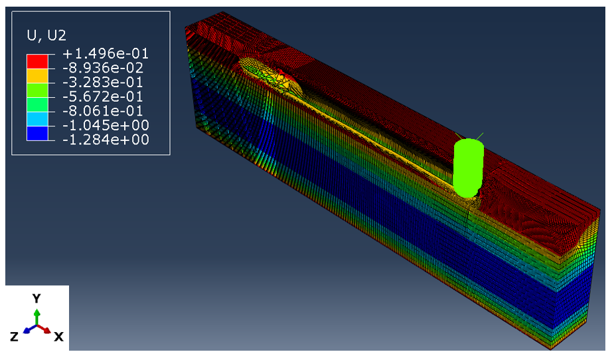
Finite element scratch model showing the indenter, polymer mesh and U2 displacement contours.
Finite element simulation of scratching a polymer sample.

Objective 1b

Dedicated experiments

Scratch polymer samples using a linear cutter.
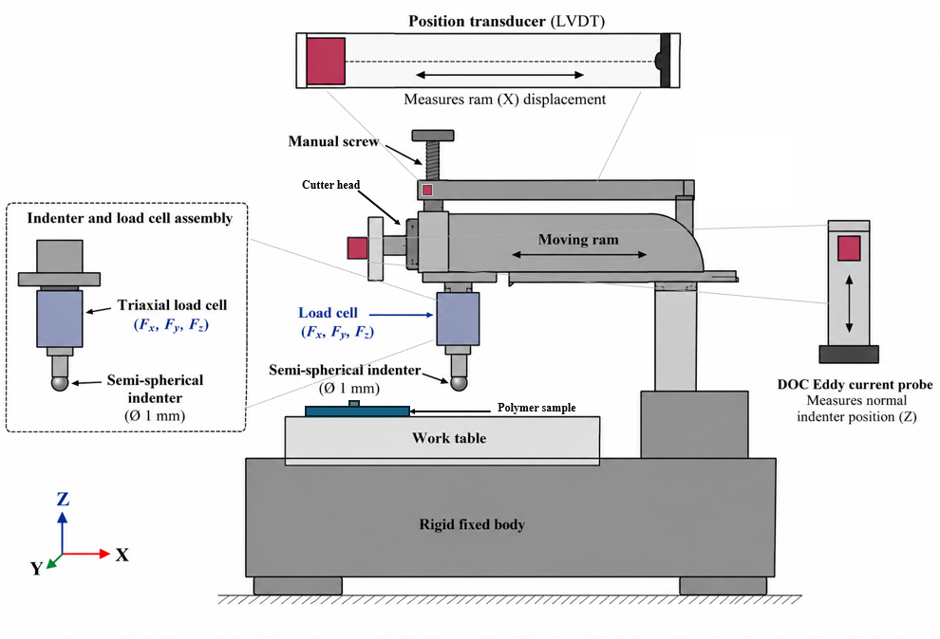
Linear cutter schematic showing the moving ram, spherical indenter, triaxial load cell, polymer sample, position transducer and eddy current probe.
Linear cutter and instrumentation for polymer scratch experiments.

Objective 1c

Cross-validation

Compare experimental and numerical results to evaluate coating resistance to abrasion.

Vertical and horizontal scratch force versus scratch distance, comparing FEM results with Test 1 and Test 4.
Comparison of experimental and numerical vertical and horizontal scratch forces.
Ongoing

Relative displacement of
pipeline & seabed

Develop a numerical model of a buried pipeline and the surrounding seabed to investigate their relative displacement.

This objective examines the relative movement that can drive abrasion at the pipeline coating–seabed interface.

Numerical modellingPipeline–seabed interaction
VIDEO Buried pipeline–seabed numerical simulation under linear wave loading.
Ongoing

Abrasion experiments &
material loss

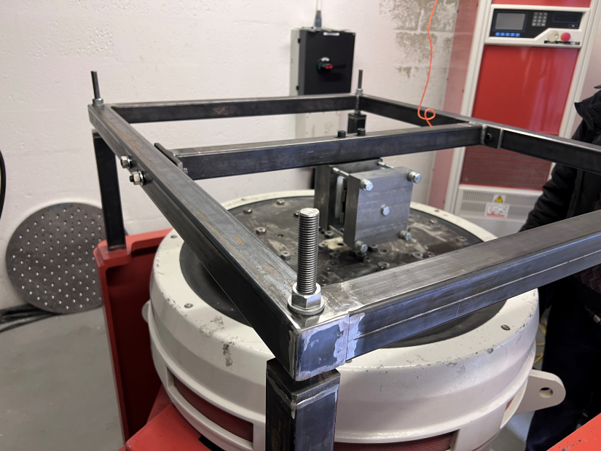
Quantify material loss from polymer samples using a dedicated abrasion rig operated on a dynamic shaker.

The experiments assess abrasion-induced material loss and provide measurements to inform the long-term degradation model.

Dynamic shakerMaterial loss measurement
Photograph of the dedicated abrasion rig mounted on a dynamic shaker in the laboratory.
OBJECTIVE 3 Dedicated abrasion rig mounted on the dynamic shaker.
Coming soon

Long-term degradation
through machine learning

Develop a machine learning model of long-term degradation due to sand abrasion, using parameters studied in the first three objectives as inputs.

This final objective brings together coating resistance, relative movement and measured material loss within a predictive framework.

Machine learningLong-term degradation

Long-term degradation model

Figure to be added
FIG. 04 Model framework & future predictions